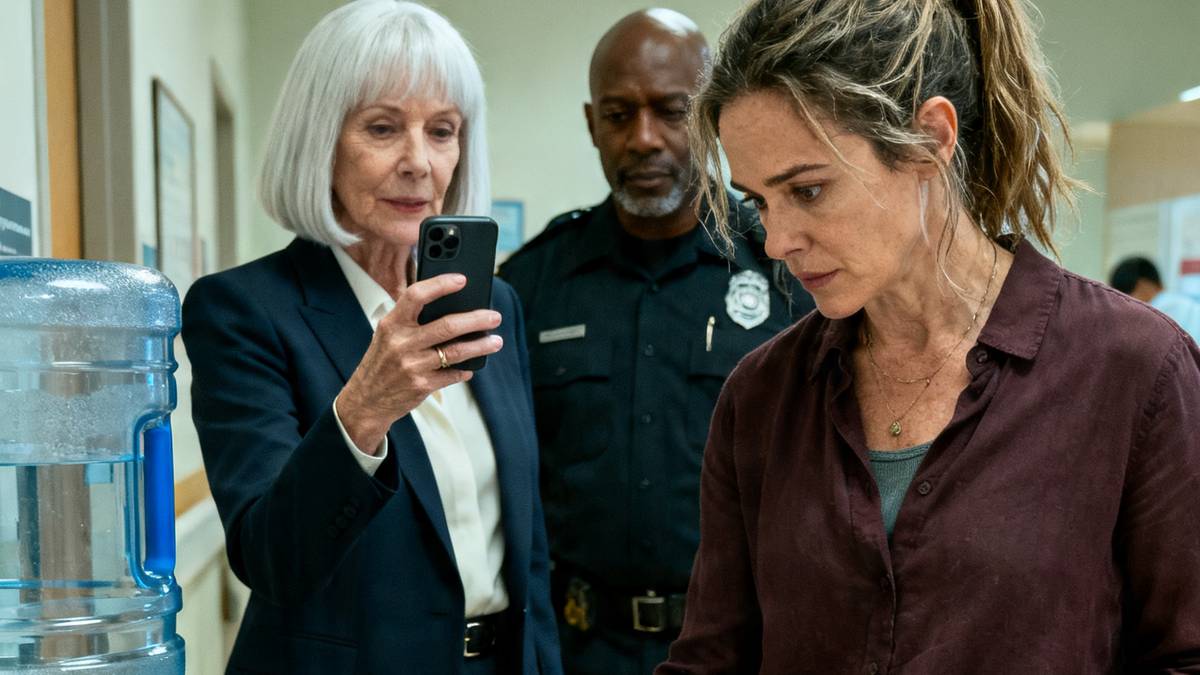
The sliding doors of the Phoenix medical plaza hadn’t even finished closing when the shouting started.
“Ma’am, I’ve told you three times now. I legally cannot release another person’s results to you.” The receptionist, a young guy named Carlos with a geometric fade and a patience level that should have gotten him a raise, didn’t even look up from his monitor.
“Another person?” The woman’s voice was sharp, the kind that cuts and then soothes itself. “I’m Eileen. Her mother. I co-signed the lease on her first bakery. I paid down the deductible on her wisdom teeth surgery last spring. Which part of that makes me *another person*?”
I stood rigid near the water cooler, the condensation from the paper cup dripping onto my knuckles. My name is Rachel, and my heart was hammering a frantic, irregular beat against my ribs. I’d scheduled the 7:30 a.m. slot specifically, turned off my location sharing, parked my old Honda four blocks away. I’d done everything short of wearing a disguise. It didn’t matter. Eileen always found the breadcrumbs.
The sealed folder on the counter held the results of a cosmetic dermatology consultation—a $400 quote for a laser peel I’d been thinking about—but to Eileen it might as well have been a classified intelligence file. She had a nose for anything I tried to keep private.
Before Carlos could repeat the hospital’s HIPAA policy for a fourth time, a door swung open and Dr. Navarro, the floor supervisor, stepped out with a security guard named Marcus. Dr. Navarro had the tired eyes of a man who spends his days dealing with human biology and his afternoons dealing with human meltdowns.
“Rachel!” Eileen’s head swiveled, her platinum bob slicing the air. She’d spotted me. “Drop this nonsense right now. Tell this man to hand over the file. Is it cancer? Is it a biopsy? I swear to God, child, if you’ve spent your money on some quack cosmetic procedure just because you’re feeling insecure about turning forty—”
“Ma’am, I need you to lower your voice,” Marcus the guard rumbled, taking a broad stance.
“Don’t you dare ‘ma’am’ me!” Eileen pulled out her phone, holding it up not to make a call but to arm a weapon. The little red record light blinked on. “Let’s get this on video, shall we? Let’s show the internet how Stone Creek Medical hides test results from a mother whose daughter is clearly in distress. Rachel, do you want this on TikTok? Because in thirty seconds, your father will see you freezing out your own mother.”
That was her go-to: public humiliation. Growing up, it was my diary read aloud at dinner. Later, it was screenshots of my bank account mailed to my first husband. When I moved to Arizona to get space, she installed cameras at the bakery and asked the delivery drivers to report my “emotional state.”
Distance had never been a boundary. It was just an obstacle she enjoyed overcoming.
But something was different in the air-conditioned chill of that lobby. Maybe it was the exhaustion, or the weight of twenty-two years of hiding perfectly ordinary things. I didn't feel the usual crushing panic. I felt hollowed out, scraped clean. All that was left was a strange, quiet calm.
I walked forward, not toward the door, but toward the counter. Taking the sealed white envelope, I looked Eileen dead in the lens of her phone camera.
“Mom,” I said, my voice barely above a whisper but clear as glass. “You’re not fighting to save me. You just want another piece of paper to hold over my head. Here it is.” I uncapped a Sharpie from the sign-in sheet and wrote VOID in heavy black letters across the front. Then I dropped the envelope into the recycling bin beside Carlos’s desk.
“This is your final decision? To treat me like a stranger?” Eileen’s voice went icy, the way it always did before delivering the final blow. “Fine. Walk away, Rachel. But the door closes behind you. I am not a revolving door for ungrateful children. You’ll lose the bakery and you’ll lose me. Is that the gamble you want to make?”
The bakery. Of course. Even now, a leash I’d built with my own hands and she’d held the deed to.
“You’ve told me I’ve lost you since I was twelve,” I said, not looking back at her. “Maybe that’s a promise you should keep this time.”
I walked out. The glass doors sealed off her screaming, but I could still feel the vibration of it in my fillings as I hit the sidewalk. The Arizona sun was blinding, bleaching the sky white. I got into the Honda, drove five blocks, pulled into a gas station, and killed the engine.
Then, I sent a text to my younger brother, Leo, who was on a fishing boat in the Gulf of Mexico.
*I dropped the peel quote in the clinic recycling. She went in after it. By tonight she’ll have it taped back together and framed.*
His reply came twenty minutes later: *Let her frame it. You okay?*
*I’m free,* I typed. *Call you tonight.*
—
Two hours later, Eileen called from an unknown number. I let it go to voicemail, but she didn’t leave one. She texted instead, a photo of her prize: a crinkled, clear-taped, coffee-stained collage of the document I’d thrown away. She’d pieced it back together from the bin.
The photo was captioned: *A FOUR-HUNDRED-DOLLAR FACE TREATMENT? THIS IS WHAT YOU HID FROM ME?*
I didn’t reply.
That night, I packed a bag in my quiet apartment. I wasn’t running. I was moving toward something warmer. At 9 p.m., I walked into the bakery, the industrial mixers silent and the air smelling of yeast and lemon zest. Leo, who’d driven straight up from the coast without sleeping, was already there, leaning against the flour-dusted butcher block.
“She’s called me sixteen times,” he said, his voice rough. “Screaming about how Dad is going to be devastated that you’re getting a ‘vain little treatment’ paid for by some sugar daddy she assumes you have.”
“Good,” I said, tying an apron on. “Let her spin that tornado. It’ll keep her busy.”
We worked through the night, not baking, but building. We re-budgeted on a whiteboard. We drafted the formal loan separation paperwork to buy out her twenty-percent stake. It would leave me cash-poor but chain-free.
At 3 a.m., my phone buzzed one last time. Eileen’s actual cell. A long, rambling manifesto about maternal sacrifice and betrayal, ending with: *Was it worth losing a mother to hide a stupid laser procedure?*
I took a picture of us—tired eyes, dusted in flour, holding the keys to a bakery that she no longer owned a piece of. I captioned it with one word.
*Yes.*
I blocked the number before the “read” receipt could even turn blue.
—
A week later, I was rolling out croissant dough at four in the morning when the front bell jingled. I looked up, expecting Leo with coffee. It was my father.
He stood in the doorway in his work boots and a faded polo, holding a plain white envelope. He didn't say hello, just walked to the counter and put it down on the flour-dusted wood.
“Your mother spent two hours last night telling me how you’re destroying your face and her reputation with a laser peel,” he said, his voice quiet. “I looked at her and I realized something I should’ve seen twenty years ago.”
He tapped the envelope. “This buys out her share. I got her to sign it. Don’t argue with me.”
I opened it. Inside was a cashier’s check for the full amount and a sticky note with two words: *Be happy.*
He turned and walked back out, the door swinging shut behind him. I stood there with sticky croissant dough on my fingers and a check that felt heavier than any bread I’d ever kneaded.
The next morning, I unlocked the bakery at 4:30 as usual. I turned on the ovens, mixed the levain, and watched the sky go from black to silver through the front window. The only sound was the hum of the proofer and my own breathing. No cameras, no calls, no Eileen—just the smell of yeast and a long stretch of quiet that belonged entirely to me.


