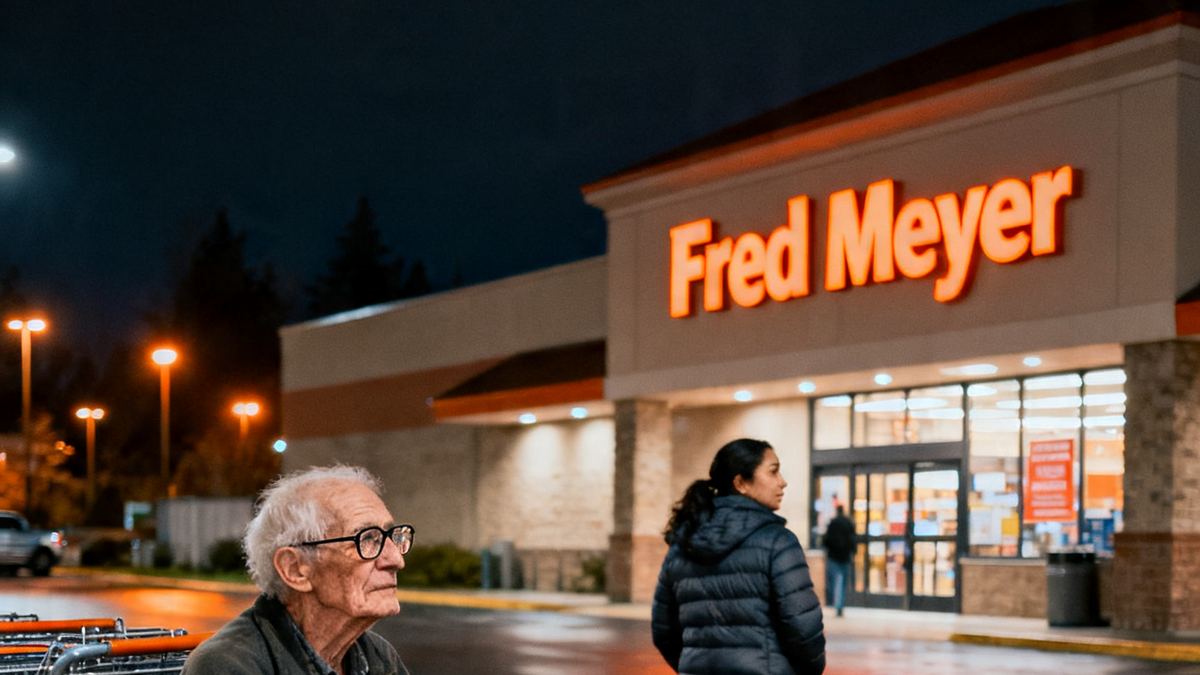
I almost kept walking.
It was one of those damp Oregon Tuesdays in mid-December, the kind where the cold doesn’t just hit your skin, it climbs into your bones. The parking lot lights at the Fred Meyer on 82nd were buzzing overhead, reflecting orange puddles on the asphalt. I was beat, thinking only about grabbing a rotisserie chicken and crashing on my sofa with the dog.
An old man was sitting on the wooden bench near the cart return. He wasn’t holding a cardboard sign. He wasn’t asking for change. He just sat there, hands resting on his knees, watching cars pull in and out like he was waiting for a train that had stopped running years ago.
I walked past him. Got maybe ten steps. Then this weird, physical resistance hit my chest. Like an invisible hand pressing me back.
I turned around.
“Sir? You waiting on someone?”
He blinked, caught off guard that anyone had spoken to him. His glasses were smudged. “Oh. No, sweetheart. Just… sitting.”
“Can I get you something inside? A coffee? It’s freezing out here.”
He started to wave me off—the automatic politeness of a man who’d learned not to be a bother—but he stopped halfway. His mouth opened, closed, and then he just nodded, almost embarrassed.
“A coffee would be… yeah. Black. If it’s no trouble.”
I went in, grabbed his coffee, and then on impulse, swung by the deli. They’d just put out a warm chicken pot pie, the steam fogging the plastic lid. I grabbed two, a bunch of bananas, some chamomile tea, and a loaf of sourdough.
When I came back out and set the bag next to him, he looked at it for a long time. Not like he was hungry—though he probably was. He looked at it like it was a foreign object. A relic from a world he used to live in.
“Thank you,” he said, his voice tight. “Not for the food. For the talking.”
I sat down. The bench was cold enough to sting.
His name was Walter. He was eighty-one. His wife, Helen, had died from a stroke four years back. His daughter, Sarah, was a paralegal in Phoenix. She called every Sunday at six p.m. sharp, but she had three kids, a brutal commute, and a mortgage that ate everything. He wasn’t bitter about it. He actually bragged about how well she was doing. But his voice trailed off when he talked about the apartment on Hawthorne Street. “The refrigerator hums so loud at night,” he said. “I never noticed it before Helen passed. Now it’s like a truck idling in the kitchen.”
We sat there for nearly an hour. He told me about working the docks in Astoria in the sixties, about taking Helen dancing at the Crystal Ballroom. I told him about my divorce, my dog Rufus, my boring job processing insurance claims.
Before I left, I tore a page out of the notebook in my glove compartment and wrote my number down. “I’m just over in Montavilla. If you need a ride to the store, or anything, call me, okay?”
He took the scrap of paper with both hands, like it was a winning lottery ticket. I honestly didn’t think I’d ever hear from him. People say “I’ll call” but they never do, right?
Three days later, my phone buzzed.
“Paige? It’s Walter. Listen, I’m real sorry to bother you. The blasted bulb in my hallway went out and I can’t get up on the step stool without my hip giving out. I tried, and I nearly took the whole wall down.”
I drove over after work. It was a small one-bedroom, stuffy and dark, filled with stacks of old National Geographic magazines. The hallway bulb was indeed dead. I changed it in thirty seconds. But then I noticed the faucet in the bathroom dripping steadily, a rusty stain pooling on the porcelain. So I called my buddy Dave, a plumber, and we got that swapped out the next day.
That’s how it started. The Sunday ritual.
Every Sunday, I’d do a grocery run. I’d show up at his door with eggs, oatmeal, maybe a box of those cheap powdered donuts he loved. We’d sit at his laminated kitchen table, pour terrible instant coffee, and he’d pull out a shoebox full of photos. Sepia-toned snapshots of Helen on the boardwalk in Seaside. Ticket stubs from a Fleetwood Mac concert in ’77. A handwritten love letter she’d slipped into his lunch pail during the Ford administration that he’d read so many times the creases had turned to holes.
One afternoon, while I was fixing the latch on his window, he looked over and said, “You know, Paige, I stopped waiting for packages a long time ago. But I still wait for the knock on the door.”
Five months rolled by. Spring hit Portland, and he was coughing less, walking a bit straighter. He’d started sitting on the front steps of his building rather than a bench outside a grocery store.
Then I got body-slammed by the flu.
Not the sniffles. The real, hallucinating, 103-degree fever, can’t-move-your-limbs plague. I was alone. Rufus was whining at the foot of the bed because he hadn’t been fed. I was shivering so bad I couldn’t reach the glass of water on my nightstand. I just lay there, drifting in and out, thinking maybe I should crawl to the car and drive myself to the ER, but I couldn’t even find my feet.
Around seven-thirty that night, a fist hammered on my front door. A weak, slow, but persistent knock.
I stumbled to the door, wrapped in a duvet, looking like a corpse.
Walter stood on the porch, leaning heavily on his cane, drenched from the drizzle. Next to him was his next-door neighbor, a quiet retired bus driver named Marcus, who was holding two giant reusable grocery bags with the straps straining.
Walter beamed. “Had to call in reinforcements,” he said, tapping his cane. “I realized I can’t carry groceries up your porch steps.”
I stared. “Walter… how did you even get here? How did you know?”
He shuffled inside, ignoring my question, directing Marcus toward the kitchen. “Marcus, put the chicken broth in the fridge. The ginger ale too. She needs fluids.”
He knew because I hadn’t shown up Sunday. Then I didn’t show up Monday. He tried calling three times, and when I didn’t answer, he pestered Marcus into driving him over, stopping at Safeway on the way. He’d bought NyQuil, Tylenol, saltines, honey, lemons, a rotisserie chicken for the broth, and a potted plant for my windowsill “because the place needs some green to cheer it up.”
He stood there in my messy living room, this frail man who struggled to change a lightbulb, and he ordered Marcus to take the trash out, ordered me back to bed, and stood guard at my stove while he heated up canned soup.
They didn’t leave until I’d eaten half a bowl and he’d watched me swallow two pills. When I woke up hours later, the fever had finally broken. The trash was gone. The dishes were done. A note was on the fridge in shaky cursive: “Didn’t want to wake you. Soup in Tupperware. Call me when you’re vertical. — W.”
A few days later, when I was back on my feet, I brought groceries to his place. We sat in our usual spots. The shoebox was on the table.
“People think they’re helping old folks,” Walter said, carefully stirring his coffee. “They don’t get it. They’re actually doing it for themselves. To prove they’re still human. Kindness doesn’t know which direction it’s going, you see. It’s just a current. If you wade into it, it carries everyone.”
I looked at that creased love letter of Helen’s, sitting near his elbow. I didn’t say anything. He just nodded, like we’d settled something important.
Last winter, I got the call from Marcus. Walter had gone to bed and just… didn’t wake up. A quiet and gentle exit, probably the kind he deserved, but it still knocked the air out of me.
After the memorial, I took a box of his things. Nothing fancy—just that shoebox of photos, the broken watch he never had the heart to fix, a few of those powdered donuts.
A few months later, on a cold, gray Tuesday, which was his birthday, I stopped by Fred’s Market after work. It was drizzling, the parking lot lights buzzing just like that first night. The bench was empty.
I bought a warm chicken pot pie and a black coffee. I sat down on the wet wood, the steam rising from the lid, watching the cars pull in and out. I let the cold soak into my jeans. I didn’t feel the need to leave.
I just watched the entrance, eating my piece of pie, the way someone waits for an old friend they know isn’t coming, but somehow, in the waiting, they show up anyway.


