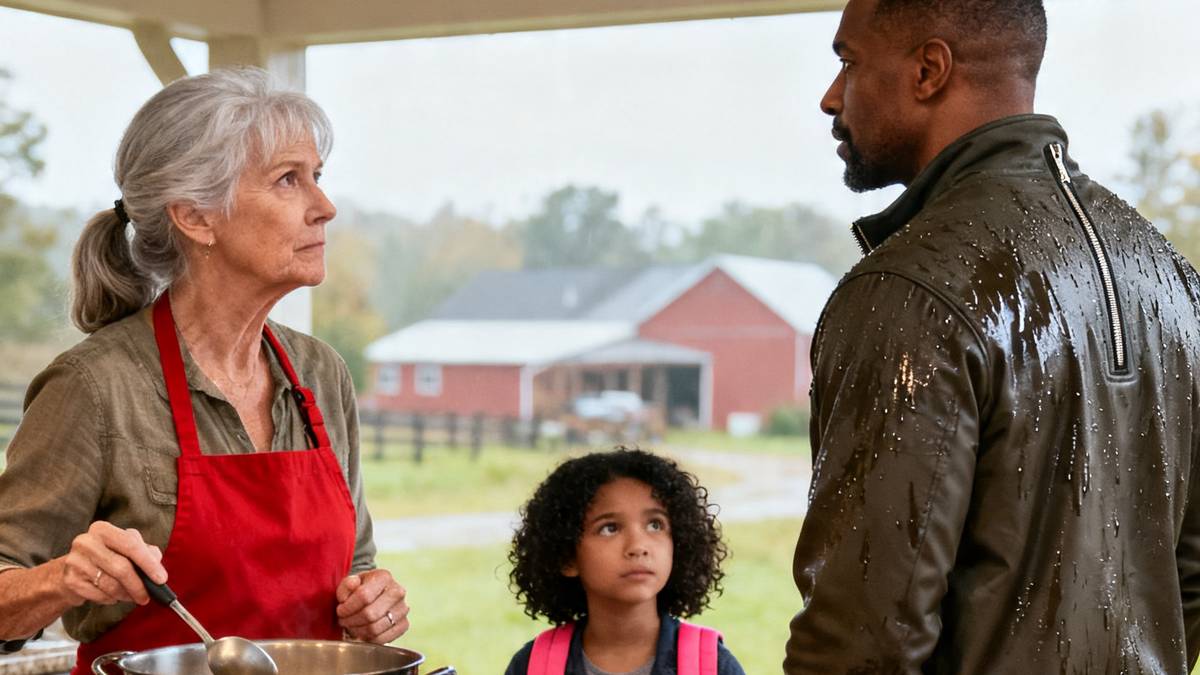
Barbara yanked the lid down so hard the whole pot shuddered on the stove. The clang cut through the kitchen like a slap.
“That’s for Grandpa. Not you lot. Your mother can figure out how to feed you.”
My nine-year-old, Mia, froze with her empty bowl still hovering over the counter. Six-year-old Leo stood right behind her, clutching a spoon he’d grabbed from the drawer, his bottom lip already trembling. We’d just pulled into my mother-in-law’s driveway forty minutes ago—four hours of driving from Boston, rain the whole way up to the Champlain Valley. The kids were wrung out and hungry. They’d smelled the chicken soup from the mudroom and lit up. Barbara’s soup was a tradition. Every fall, she’d make a massive pot for the first cold weekend. This time we’d come unannounced, hoping to surprise her, my husband Ryan’s idea. He wanted the kids to see the farm before his dad’s health got any worse. I’d loaded the trunk with gifts: a new wool sweater for Barbara, fancy maple syrup, a board game for Grandpa Frank, who spent most days in the recliner with the TV on loud. But from the moment we walked in, Barbara seemed frayed. She’d barely glanced at us before snapping at Frank to turn down the volume. The kitchen smelled right, but the welcome was off.
Ryan was still bringing in suitcases from the car when I heard the lid bang down.
“Mom, what are you doing?” He stepped into the kitchen, his jacket half-zipped, rain dripping from his hair.
“I’m setting aside Frank’s dinner. He needs something gentle on his stomach, not a bunch of kids picking through it.”
“They haven’t touched anything. They just want a bowl of soup. There’s a whole pot here.”
“I’m not running a soup kitchen, Ryan. I cooked for your father. Your wife can open a can of something if she’s that worried. I didn’t push out those babies—she did.”
Leo wrapped both arms around my leg, his voice tiny. “Did we do something wrong?”
I couldn’t get words out. My throat locked. Ryan rounded the island and stood square in front of his mother. He was a big man—could have just taken the ladle and served them himself—but he didn’t touch the stove. He looked her in the eye, his voice very quiet.
“Mom, fill up two bowls. Right now.”
“Don’t you dare give me orders in my own kitchen. I raised you by myself while your father was out on the road. I gave you everything I had. I think I’ve earned the right to decide who eats what in my own house.”
From the living room, the weather channel kicked up a notch. Frank had turned the volume higher. Barbara didn’t move from in front of the pot. She folded her arms, the ladle hanging from one hand like a weapon.
Ryan didn’t raise his voice. He just nodded once, slowly.
“Alright. Kate, get the kids’ coats. We’re leaving.”
“Where are you going at this hour?” Barbara sputtered. “It’s pouring.”
“There’s a motel down in Vergennes. For fifty bucks a night at least someone will serve my kids with a smile.”
“Over soup? You’re really tearing this family apart over soup?”
Ryan turned his back to her and knelt in front of Leo and Mia. “It’s not about the soup, Mom. It’s about the fact that my children just stood in your kitchen and felt like strangers. That’s not happening again.”
The car was silent except for the wipers. I twisted around in the passenger seat to look at the kids. Mia was staring out the window, her pink backpack crushed against her chest. Leo had fallen asleep with tears still wet on his cheeks. After a few miles he woke up and asked the question that cracked something inside Ryan’s chest.
“Daddy, does Grandma not like us?”
Ryan’s knuckles went white on the steering wheel. He didn’t answer right away. The rain hammered the roof. Finally he said, “This isn’t about you. You didn’t do anything. You hear me?”
“But she had soup,” Mia whispered. “A whole pot. And she said no.”
We found a small motel off Route 7. The woman at the front desk—a cheerful grandma type named Elaine—took one look at the kids and asked if they’d eaten. I shook my head. “I was just about to sit down to some tomato soup myself,” she said. “There’s plenty. Let me grab you some.” Ten minutes later she came back from her own apartment behind the office with two mugs of hot tomato soup, saltines, and sliced apples. Leo picked up his spoon like he was waiting for someone to snatch the bowl away.
“Can I really have this?” he asked me.
“Of course, sweetheart.”
He didn’t take a bite until he saw me nod twice.
After the kids were asleep, Ryan sat on the edge of the lumpy mattress, elbows on his knees. “I’m sorry.”
“You stood up for them.”
“I should have done it years ago. I kept hoping she’d change.”
“You stood up for them today. That’s what counts.”
The next morning, Barbara’s text came through before sunrise: *When you’re done with the drama, come back. There’s still soup left.* Ryan showed me the screen, his jaw tight. He typed back: *We won’t be coming back for leftovers. We’ll come back when you apologize to Mia and Leo. To their faces.* Her reply was instant: *I will not grovel to children.*
Ryan set the phone on the nightstand. “Then she’s not going to see them.”
We spent the rest of that vacation in the motel. It cost more than we’d budgeted, but the kids didn’t complain. We drove to the lakeshore even though it was freezing, fed ducks at a pond in Middlebury, let them pick out lollipops at a general store. It was peaceful. For the first time I saw Ryan truly angry at his mother—not hurt, not resigned. He carried it like a quiet weight, and each time he read a message from her, he set the phone down with a finality that said the door was shut. When Barbara called later and blamed me for poisoning her son against his family, Ryan cut her off. “Kate wasn’t the one who slammed the lid in front of my kids,” he said. “You were.”
A week before Christmas, a manila envelope arrived in the mail. Inside were two handmade cards with stickers of snowmen. The note inside Mia’s read: *Mia, I was wrong. There was enough soup for everyone, and I pretended there wasn’t. I am so sorry I hurt you.* Leo’s was shorter, with shaky handwriting: *I am sorry, Leo. I should have fed you first.* Mia held the card for a long time.
“Do we have to forgive her?” she asked.
Ryan sat down on the floor next to her. “No, sweetheart. You don’t have to. Only if you ever want to, and not before you’re ready.”
In April, when the snow finally melted, we drove back up for one afternoon. No suitcases this time. No gifts in the trunk. Barbara met us at the door in an apron, her hair freshly curled. The kitchen smelled like she’d been cooking since dawn. On the big oak table were six bowls stacked neatly, six spoons, a plate of buttered bread. The soup pot was bubbling on the stove, twice as big as the one from that night.
She didn’t say much. She just pointed to the chairs.
Leo clutched my hand and looked at the bowls, then at Barbara. “Is it for me, too?”
Barbara’s eyes glistened. She crouched down—something I’d never seen her do—and her voice cracked. “You first, sweetheart. I made it for you first.”
That meal didn’t erase the night the lid came down. Mia still flinched a little when she walked into that kitchen. Leo still watched Barbara’s hands near the stove. But they sat at the table, and they ate, and Ryan stood in the doorway with his arms folded, watching his mother ladle soup into his son’s bowl with a trembling hand. He didn’t smile. He just nodded once, the same way he had when he told her we were leaving. She saw it, and she nodded back. That was enough.


