Maggie had been my next-door neighbor for eleven years, and I’m not sure we’d spoken more than two hundred words in all that time. She was a quiet woman in her late sixties who watered her petunias at dawn and never made a sound through the walls. I was the one always running — slamming the car door at seven-fifteen, dragging the trash bin to the curb at midnight, yelling at someone on a work call while I paced the driveway. We waved. We nodded. We borrowed nothing from each other.
So when my entire life collapsed over a single Tuesday in October, Maggie was the last person I expected to show up.
It started as a migraine — the kind where the light feels like an ice pick behind your left eye. By Wednesday morning, I couldn’t stand without the room tilting. By Thursday, I was so dehydrated and feverish I couldn’t keep water down. I remember staring at my phone on the nightstand, watching texts pile up from my boss, my sister in Phoenix, a guy I’d been on three dates with. I didn’t answer any of them. I just lay there under a sweat-soaked comforter in my studio apartment in Pittsburgh, thinking: *if I die right here, it’ll be three weeks before anyone notices the smell.*
Friday afternoon, I heard the knock. Not the sharp, insistent knock of a delivery driver — just three soft taps, like someone wasn’t sure they should be knocking at all.
I didn’t move.
Then a voice, muffled through the door: “It’s Maggie. From next door. I haven’t seen your car move since Tuesday, and your mail is piling up. Are you okay in there?”
I croaked something. I don’t even know what. But she must have heard the wreckage in my voice because the next thing I knew, a key was turning in the lock.
Turns out my landlord had given her a spare years ago, “just for emergencies.” I’d forgotten that. She hadn’t.
Maggie walked into a room that smelled like sickness and stale laundry, saw me gray-faced and shaking under a heap of blankets, and didn’t flinch. She set down a canvas tote on my kitchen counter, pulled back the curtains to let in thin October light, and said, “All right. Let’s get you sorted out.”
For the next six days, Maggie ran my life.
Every afternoon she’d let herself in, quiet as a ghost. She’d bring a fresh quart of chicken broth from the deli on Murray Avenue, a sleeve of saltines, those electrolyte tablets that fizz in water. She’d strip the bed while I shuffled to the bathroom, wash the sheets in the building’s basement coin laundry, and have them back on the mattress before I could even feel embarrassed about it.
She never asked if I wanted her there. She just *was* there.
Sometimes, half-asleep, I’d hear her moving around the kitchen — opening drawers slowly so they wouldn’t slam, setting a spoon down with the care of someone handling a museum piece. She’d leave a glass of water and two Tylenol on the nightstand, then slip out.
Once, I managed to say, “Maggie, you don’t have to do this. I’m a stranger.”
She just said, “Nobody’s a stranger when they’re sick.”
On the seventh day, my fever broke around four in the morning. I woke up drenched but clear-headed, the way you do after a storm passes. For the first time in a week, I walked to the kitchen on my own two feet.
The apartment was immaculate. The pile of dirty dishes — gone. The sour laundry draped over the armchair — folded into a neat stack on the dining table. There was even a small vase of orange marigolds next to the sink, the kind they sell at the farmer’s market for three dollars a bunch.
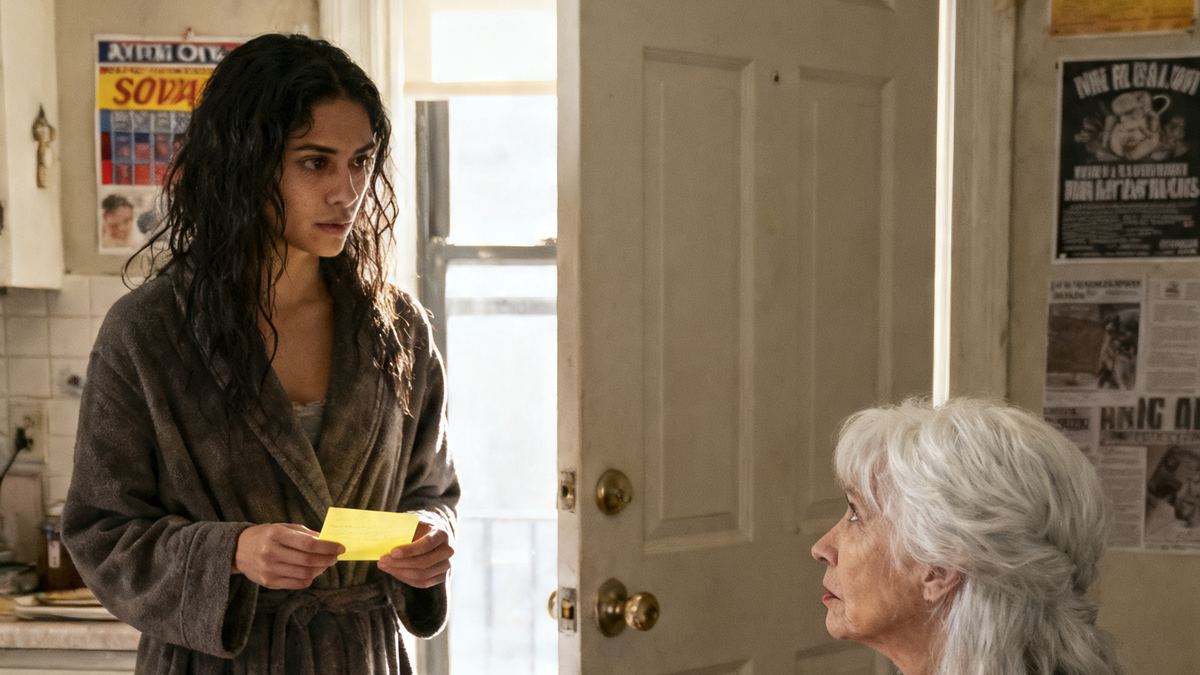
But what stopped me cold was a yellow Post-it note stuck to the coffee maker.
Six words in neat, slightly shaky cursive:
*“You carried me once. I remember.”*
I stared at that note for a long time.
I had no memory of carrying anyone. I barely remembered to send my own mother a birthday card. What could I possibly have done for a woman I’d spent a decade treating as background furniture?
The lock clicked. Maggie came in holding a paper bag from the pharmacy, and when she saw me standing there with that yellow square in my hand, she froze.
“Oh,” she said.
“Maggie, what is this? I don’t… I don’t remember doing anything for you. I don’t think I’ve ever done anything for you.”
She set the bag down on the counter. For a long moment, she didn’t speak. Then she pulled out one of the kitchen chairs and sat.
“You want coffee first, or the story?”
I sat across from her.
She told me that fourteen years ago, her daughter Lily got sick. Really sick — the kind that burns through a child’s body and a parent’s savings at the same speed. Maggie had just gone through a divorce that left her with the apartment, a part-time job at a daycare, and exactly no safety net. Lily needed treatments at Children’s Hospital three times a week. The copays alone were eating them alive.
“One week in February,” Maggie said, “I had to choose between Lily’s medicine and the electric bill. I chose the medicine. We spent three nights with flashlights and an electric skillet. And then, on the fourth morning, I opened the front door and found a grocery bag sitting on the mat.”
Inside the bag: a gallon of milk, a loaf of wheat bread, a jar of peanut butter, a bag of apples, and an envelope with two hundred-dollar bills. No name. No note — except a torn piece of notebook paper with one sentence.
Maggie pulled a folded paper from her pocket. It was old and soft at the creases, the blue ink faded but still legible.
*“You’re not invisible. Someone sees you.”*
I knew that handwriting.
It was mine.
And then it hit me. Not all at once, but in pieces that rearranged themselves behind my eyes.
February. Fourteen years ago. I’d been living in this building for about a year, fresh out of college, working my first real job. One night I’d come home late and overheard two neighbors talking in the laundry room — something about the single mom in 3B, the little girl with the sad eyes, the lights that had been off in their windows for days.
I remember going to the Giant Eagle on Centre Avenue that same night. I remember standing in the greeting card aisle, trying to think of something to write, and settling on something that felt small and inadequate. I slipped the bag onto her doorstep at six in the morning, before anyone was awake, and then I just… forgot.
It had been a hundred-dollar impulse. A moment of guilt and pity that cost me less than a nice dinner out. I’d never thought about it again.
“I saw a handwritten sign you taped in the lobby a few months later,” Maggie said. “‘Lost cat, gray tabby, answers to Smokey.’ I recognized the loops on your Y’s. That’s how I knew.”
She smoothed the old scrap of paper against her knee.
“I cried that February morning until I couldn’t breathe. Not because of the money — because someone had seen me. In the worst, loneliest moment of my life, a stranger had looked at me and said: *you matter.*”
My throat was closing up.
“I’ve been waiting fourteen years,” Maggie said quietly. “Waiting for the day I could give it back. When your mail piled up last week, I just… I knew.”
I didn’t know what to say. So I didn’t say anything. I just reached across the table and took her hand. She squeezed it once, hard, and neither of us let go for a while.
That was three years ago.
Maggie’s daughter Lily is twenty-two now, healthy and sharp as a tack, and she calls me Aunt Delia even though we’re not blood. We spend holidays crammed around Maggie’s tiny dining table — the three of us plus whatever strays Lily drags home from college. Last Christmas, Maggie burned the ham and I forgot to buy napkins, and we laughed until the neighbors on the other side banged on the wall.
Every Wednesday night, weather permitting, we sit on the building’s front steps with cups of tea and watch the city go dark. Sometimes we talk. Sometimes we don’t.
Last week, as we were heading inside, Maggie paused with her hand on the doorframe.
“I almost didn’t open that bag, you know,” she said. “Fourteen years ago. I almost kicked it aside. I was so tired I didn’t believe anything good could still land at my feet.”
“Why did you open it?”
She looked at me, her eyes crinkling in that way they do.
“Because I was hungry.”
I laughed. She laughed. And we walked inside together, into the warm light of the hallway we’ve shared for more than a decade.


