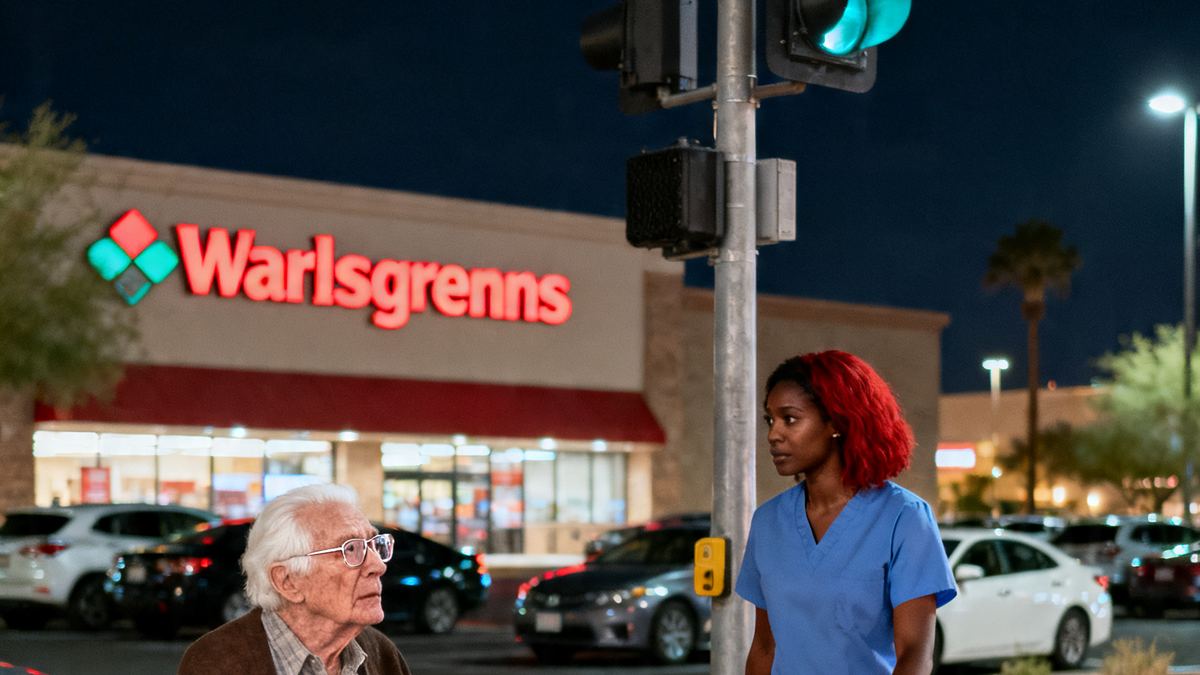
I almost walked right past him.
It was a Tuesday night in Phoenix, the kind of late August heat that makes the asphalt shimmer even after dark. I’d just finished a twelve-hour shift at the hospital, and the only thing on my mind was getting a bottle of wine, a frozen pizza, and collapsing into my bathtub. My feet were screaming. My scrubs smelled like antiseptic and somebody else’s day. I was not in the mood to notice anyone.
But he was just… there. An old man on the bench outside the Walgreens on Seventh Street.
He wasn't holding a sign. Wasn't shaking a cup. Wasn't doing anything, really. Just sitting with both hands on the head of a worn-out wooden cane, staring at the traffic light changing from red to green to red again. He had the posture of a man who'd been waiting for a bus that had stopped running years ago.
I pushed my cart through the automatic doors, grabbed my sad little dinner, and got in line. But I couldn't shake it. Something about the way he just sat there, completely still in the middle of a city that never stops moving.
*Go back.*
I hate that voice. It gets me into trouble. I ignored it, paid for my stuff, and walked out. Got all the way to my car. Popped the trunk.
*Damn it.*
I left my groceries in the trunk and walked back. He didn't see me coming until I was standing right next to him.
"Sir? You okay? You need me to grab you something from inside?"
He blinked up at me, and for a second he looked almost startled, like a man waking from a nap he didn't mean to take. His eyes were a watery blue behind thick glasses.
"No, no, sweetheart. I'm fine. Just waiting."
"Waiting for someone?"
A long pause. He looked back at the traffic light.
"You know, I'm not sure anymore."
That hit me in a way I wasn't prepared for. I stood there for an awkward beat, then went back inside. I put the wine back. I grabbed a rotisserie chicken that was still warm, a container of mashed potatoes, a bottle of water, a fresh pack of butter cookies, and one of those little bouquets of daisies they keep by the register for five bucks. No idea why the flowers. It just felt like a man who hadn't been handed flowers in a long time.
When I came back out and set the bag next to him on the bench, he looked at it. Then at me. His chin trembled just a little.
"Thank you," he said. His voice was thin, like paper. "Not for the food. For talking to me."
I sat down. I don't know why. My feet were killing me and the bench was hard and the heat was like a wet blanket, but I sat down anyway.
His name was Walter. Walter Dempsey. He was eighty-two. His wife, Gloria, had died four years ago of a stroke that took her in her garden, right in the middle of the tomato plants. His daughter, Linda, lived up in Seattle with her husband and two kids. She called every Sunday at six p.m. sharp. She was a good daughter, he said. She was just busy. Everybody’s busy. He didn't say it with any bitterness. It was just a fact, like the heat.
"The hardest part," he said, looking down at the daisies, "is when the ice maker in the freezer drops a new batch. That little crash. It used to make Gloria jump every time. Now it just echoes."
We talked for forty-five minutes. I learned he'd been a high school history teacher for thirty years. That he'd marched in Selma in '65. That he once met Muhammad Ali in an airport and was too starstruck to speak. That he still set out a second coffee cup in the morning, not out of habit, but out of hope.
Before I left, I scribbled my number on the back of the Walgreens receipt and tucked it into the cookie package.
"If you ever need anything from the store, or just… you know, anything. Call me. I'm Maya."
He nodded, but I figured that was the end of it. A nice moment. A story to tell my friends. I didn't expect to hear from him again.
Two days later, my phone rang.
"Maya? This is Walter. From the bench. I am so sorry to bother you. It's… my window. The one in the living room. It's been stuck for six months and the forecast says 115 tomorrow and I can't get the air to circulate. I used to get up on a step stool but my son-in-law made me promise…"
I was at his apartment that evening. A small one-bedroom over by Encanto Park, filled with books and framed photographs and the faint, sweet smell of pipe tobacco that hadn't been smoked in years. I unjammed the window. Then I noticed the kitchen faucet was dripping. Then I saw the lightbulb out in the hallway.
And just like that, it became a thing. A rhythm.
Every Thursday after my shift, I'd swing by. I'd bring a rotisserie chicken—our thing now—and sometimes a six-pack of Coors, which he called "Colorado Kool-Aid." We'd sit on his little balcony and watch the bats come out over the park. He told me about marching in Chicago in '68, about the first time he kissed Gloria at a drive-in movie, about the student who came back twenty years later to thank him for believing in him when nobody else did.
He showed me letters. Real letters, on paper, tied with a red ribbon. Love letters from Gloria when he was stationed in Germany. He read me one once, and his voice didn't waver, but his hands did.
One Thursday he said, "You know, Maya, I stopped waiting for birthdays. Stopped waiting for holidays. The only thing I wait for now is the sound of your knock on that door."
I had to get up and go to the bathroom so he wouldn't see me cry.
Three months later, I got sick. Not a cold. The real thing. A flu that hit me like a freight train. Fever of 103. I was delirious, alone in my apartment, drifting in and out of a fever dream where I kept trying to call in sick to a job I hadn't worked in ten years. I couldn't move. Couldn't eat. Could barely remember my own name.
Around seven in the evening, there was a knock at my door. Hard. Insistent.
I crawled out of bed, literally crawled part of the way, and opened it.
Walter. Standing there with a man I recognized from his apartment building, a burly retired firefighter named Marcus who lived on the second floor. Marcus was holding two giant grocery bags.
Walter leaned on his cane, slightly out of breath from the stairs, and gave me a little grin.
"I owe you an apology. I realized I couldn't carry all this myself."
The bags were packed. Chicken broth. Lemons. A jar of local honey. NyQuil. Ibuprofen. Tangerines. Ginger ale. And on top, of course, a warm rotisserie chicken.
"How did you even know I was sick?"
He tilted his head and looked at me like I'd asked him how he knew the sky was blue.
"Sweetheart, you haven't missed a Thursday in three months. I figured either you were on a beach in Tahiti and forgot to send a postcard, or you were flat on your back with a fever. I took a gamble on the fever."
They didn't just drop off the food. Marcus fixed the chain on my ceiling fan that had been broken for a year. Walter sat on the edge of my bed and made me eat soup while he told me a story about a student who once tried to cheat on a test by writing answers on the inside of his glasses. By the time they left, my trash was taken out, my kitchen was cleaner than it had been in weeks, and my fever had broken just enough that I could think straight.
When I was back on my feet the next week, we had our usual Thursday on the balcony. The bats were out. The Coors was cold. The desert sky was turning that impossible shade of purple.
Walter was quiet for a minute. Then he said, "People think they're helping old folks. That's the story they tell themselves. The soup kitchen volunteer. The girl who brings a chicken. It's a one-way street in their heads. But it's not." He tapped his cane on the concrete. "Kindness doesn't know anything about one-way streets. It circles the block. It always finds its way back to the person who sent it out. You just have to wait on the bench long enough."
Two years and four months later, I got the call from Linda, the daughter in Seattle. It was a Sunday. Six-fifteen p.m. He'd missed his Sunday call for the first time in years, and she'd had the super check on him. A heart attack in his sleep, they said. Peaceful.
I still live in Phoenix. I still work at the hospital. But every year, on Walter's birthday, October 14th, I buy a warm rotisserie chicken and a six-pack of Coors. I drive over to the Walgreens on Seventh Street. I sit on that bench. I leave a bouquet of daisies. And I wait, watching the traffic light change from red to green to red, until the bats come out over the park, and the heat finally breaks, and the whole desert takes a long, slow breath.


