Denise had a way of arriving that made you feel like a tenant in your own life. I’d hear her key in the lock before eight a.m., and by the time I shuffled into the kitchen, she’d already have my coffee maker disassembled on the counter, clucking her tongue at the water reservoir.
“You’re supposed to descale this monthly, Liz. Didn’t your mother teach you anything about keeping a home?”
My mother had taught me plenty. How to parallel park a tractor by the age of twelve. How to stretch a pound of ground beef into a week’s worth of meals when the oil field checks didn’t come through. How to smile and say “yes, ma’am” to people who’d never worked a day with their hands but had plenty to say about how you folded your napkins.
But Denise didn’t want to hear about my mother. Denise wanted an audience.
My husband, Josh, sat at the breakfast bar scrolling through his phone, earbuds in. He’d perfected the art of being present without being available. Thirty-one years old, a solid job in commercial HVAC sales, and a complete inability to look his mother in the eye and say the word “stop.”
“I’m going to run to the store,” Denise announced, wiping her hands on a dish towel that she’d brought from her own house because she didn’t trust ours. “The milk in here is practically sour. And I saw some stains on the grout in the guest bathroom. Liz, I’ll pick up a brush while I’m out. You clearly don’t own one.”
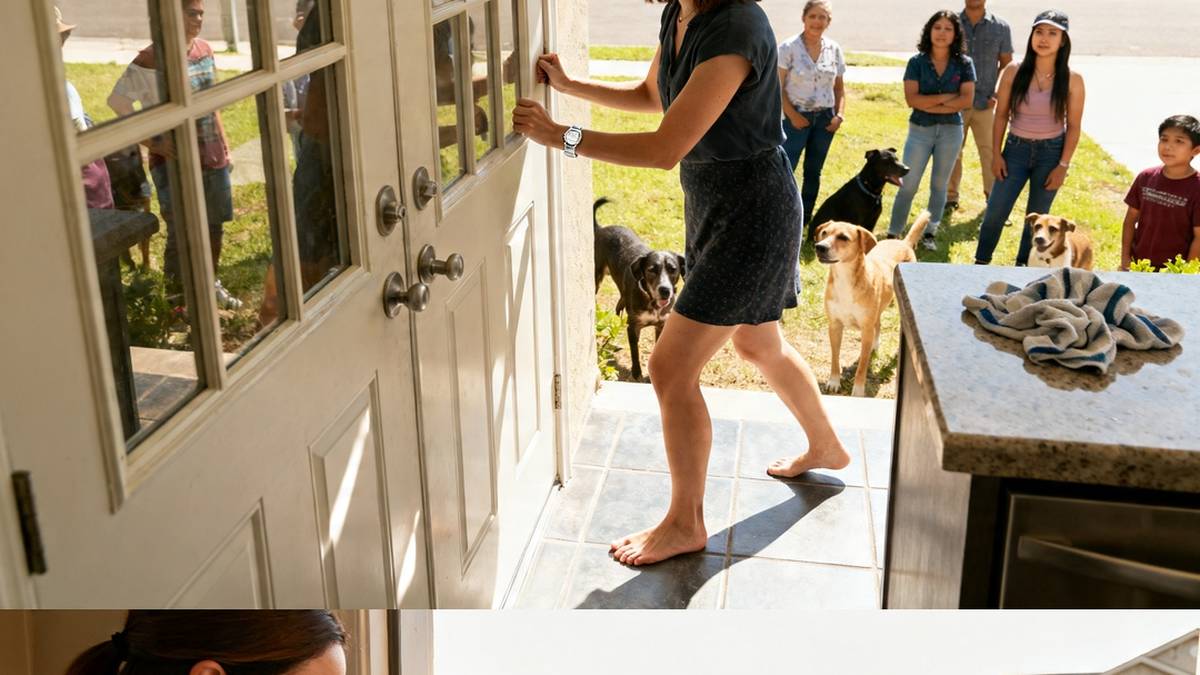
She left the towel crumpled on my cutting board, damp and wadded up, and breezed out the front door without closing it all the way. A strip of Texas heat pushed into the foyer, thick and unapologetic. It was July in Austin, and even the cicadas sounded exhausted.
I stood there, barefoot on the tile, staring at the front door she’d left ajar. Josh pulled out one earbud.
“You know she just wants to help.”
I didn’t answer. I walked over and pushed the door shut until I heard the latch click.
That afternoon, I sat in my car in the parking lot of a Walgreens and didn’t go inside. The air conditioner blasted my face, and I watched an old man methodically load bags of potting soil into the trunk of a Camry, one after another, taking his time. I felt something settle in my chest. A kind of stillness that wasn’t peaceful—more like the moment right before a shelf bracket gives way and everything slides off.
Josh and I had met in college. I was the scholarship kid from Midland who worked the late shift at the library, and he was the good-natured business major whose parents had bought him a condo near campus. We’d been married four years. Four years of Denise showing up unannounced with critiques disguised as concern. Four years of Josh saying, “She’ll come around, babe. She just wants to make sure you’re right for me.”
The fight happened on a Tuesday. Not a big, explosive one—nothing worthy of a movie scene. Denise had called while we were eating dinner to tell Josh that she’d seen my car parked at a bar downtown the previous Thursday. She’d driven by. Just happened to notice. Was everything okay at home?
I had been at a work happy hour. I’d told Josh about it. He’d forgotten.
But instead of telling his mother that, he said, “I’ll look into it, Mom,” and hung up, and when I asked him why he made me sound like an employee under investigation, he shrugged and said, “You know how she gets.”
“I know how you let her get,” I said.
He didn’t argue. He just looked at me with this tired, confused expression, like I was suddenly speaking a language he’d never heard.
I moved out the following week. Took the guest room mattress because it was the only one I could wrestle into the back of my Subaru by myself. My friend Tanya let me crash on her pull-out couch in her one-bedroom over in South Congress. The springs dug into my hip, and the streetlight outside the window buzzed all night, but nobody let themselves in with their own key and reminded me to soak the showerhead in vinegar.
I cried exactly once. In the shower, where nobody could hear, with the water running so hot my skin turned pink. Then I got out, toweled off, and opened my laptop.
I was twenty-seven years old with a marketing degree I’d never fully used and a job as an office manager for a mid-tier dental practice. But I’d been tinkering for months with a little side project—a fintech blog that explained investment basics for women who’d never been taught. Compound interest, index funds, the whole “your money should work harder than you do” pitch. I’d been writing it in secret, late at night, because Denise had once seen my browser history and said, “Investing? Don’t you think that’s a little ambitious for someone with your background?”
From Tanya’s pull-out couch, I published my first real piece. Then another. Then I started recording short videos on my phone—two-minute explainers in my car during lunch breaks, no fancy lighting, just me talking into the lens like I was having coffee with a friend.
The thing about women who’ve been told they don’t belong is that they recognize each other. My comments section filled up with strangers saying, “Nobody ever explained this to me before.” A local Austin podcast had me on as a guest. Then a bigger one. Six months in, I’d built an email list of forty thousand people, and a small investment firm offered to sponsor a weekly newsletter. The money wasn’t huge, but it was more than the dental practice paid.
I quit my job on a Friday. Walked out with a box of my things and a cactus Tanya had given me for my desk. Sat in my car in the same Walgreens parking lot, looked at the same old man who was apparently there every day loading something into a Camry, and laughed until my stomach hurt.
Josh called occasionally. His voice always had this tentative quality, like he was testing the ice on a frozen pond. He’d ask how I was doing, and I’d give him the surface-level version, and then there’d be this long pause where I knew he wanted to say something about his mother but couldn’t quite figure out how to start.
“Mom asks about you,” he said once.
“No, she doesn’t.”
He didn’t correct me.
Eighteen months after I left, I bought a townhouse. A real one, in East Austin, close to the lake—two bedrooms, a small fenced yard with a mesquite tree I didn’t have to water, a kitchen with a window over the sink that caught the morning light. I signed the papers alone, with a pen I’d stolen from the dental office years ago and kept as a good-luck charm.
The first night, I sat on the front steps with a beer and watched the sun go down behind the rooftops. The porch light was one of those motion-sensor ones that clicked on automatically when it got dark. I didn’t have to install it. It just came with the place.
Denise found out through the grapevine—her sister’s hairdresser’s daughter had seen me on a local morning show, a three-minute segment about the gender investment gap. She called Josh immediately.
The next evening, he showed up at my door. Not the townhouse door—I hadn’t given him the address. He was waiting by my car in the parking lot of the grocery store, leaning against the trunk of his truck like some kind of ambush detective.
“She’s losing her mind,” he said.
I set my grocery bags in the back seat. “About what, exactly?”
“The townhouse. The TV thing. All of it.” He rubbed the back of his neck. “She keeps asking how you managed it. You know, on your own.”
“On my own,” I repeated, and something in my voice made him flinch.
“She doesn’t mean it like that.”
“Josh.” I shut the car door and faced him. The parking lot lights flickered on overhead, buzzing faintly. “She means it exactly like that.”
He looked at me, and for a second I saw something flicker behind his eyes—maybe the realization that he’d spent his whole life defending a woman who’d never once defended him. Or maybe just the exhaustion of standing in a grocery store parking lot at seven p.m. trying to bridge a gap that had been there long before I came along.
“She wants to see the place,” he said.
“No.”
“Liz…”
“She threw away my grandmother’s recipe box, Josh. The one thing I had from her. She said it was taking up counter space. I found it in the recycling bin under a pizza box.”
He didn’t have a response to that. Most people wouldn’t.
Denise came anyway. Of course she did. Two Sundays later, my doorbell rang while I was still in my robe, and there she was on my porch, dressed like she was attending a garden party—white linen, gold earrings, lipstick applied with surgical precision. She held a bottle of prosecco in one hand like it was a passport granting her entry.
“I brought a little housewarming gift,” she said, smiling brightly. “Aren’t you going to invite me in?”
I didn’t move from the doorway. “I wasn’t expecting you.”
“Well, that’s the fun of surprises, isn’t it?” She tilted her head, taking in the foyer behind me—the hardwood floors, the staircase, the art on the walls I’d chosen myself. “This is quite the step up from that little apartment. Josh said you’d done well for yourself, but I had no idea.”
She stepped forward, clearly expecting me to step aside. I stayed where I was.
“Denise, I’m going to be honest with you. You were never kind to me. Not once. And I’m not interested in giving you a tour of the life I built after your son let you chase me out of my own home.”
Her smile tightened, but it didn’t slip. She was too practiced for that. “That’s a very dramatic way to put it. I never chased anyone. I only ever wanted what was best for Josh.”
“No,” I said. “You wanted what was best for you. And I was in the way.”
The silence that followed was the first honest thing that had ever passed between us. She stood there, holding the prosecco, and I stood there in my robe, and the mesquite tree in the yard rustled in a sudden breeze.
“Well,” she said finally, her voice cooler now, stripped of its fake warmth. “I can see you haven’t changed.”
“You’re right. I haven’t.” I let that hang. “But everything else has.”
She left the bottle on the porch steps—didn’t hand it to me, just set it down like an offering at an altar she didn’t believe in—and walked back to her car without looking over her shoulder. I watched her drive away, then picked up the prosecco, walked inside, and put it in the fridge.
I still haven’t opened it. I might, someday. Or I might give it to Tanya. She always did like the good stuff.
Three years later, I’m sitting in a radio studio downtown, headphones on, microphone angled toward my mouth, waiting for the producer to give me the signal. “The Liz Hartley Show” is syndicated in fourteen markets now. We talk money, power, and the quiet ways women learn to disappear. Sometimes we just talk about life.
The call screener flashes a name on the monitor. I almost laugh when I see it. Almost.
“We’ve got Denise in Austin on the line,” I say into the mic, my voice steady and warm. “Denise, you’re on the air. What’s on your mind today?”
There’s a pause. A cough. And then her voice comes through the headphones—older now, a little thinner, but unmistakable.
“I was just wondering,” she says, and I can hear the strain underneath the polished tone, the effort it’s taking to sound casual, “how a girl from nowhere with no connections ends up with her own show and a house on the east side. Don’t you think your listeners deserve to know where you really came from?”
The producer’s eyes go wide in the booth. He’s reaching for the dump button. I shake my head at him, hold up a hand. I’ve got this.
“Well, Denise,” I say, leaning into the mic, “that’s a great question. I came from Midland. My mom was a waitress, my dad worked the rigs until his back gave out. I put myself through school, built a business from a pull-out couch, and bought my house with money I earned by teaching other women how to do the same. Does that answer your question?”
Silence. The kind that stretches and bends and makes radio producers sweat.
Then, quietly: “I suppose it does.”
“I’m glad.” I let my voice soften, just a little. “Thanks for calling in. I hope you’re doing well.”
I signal to the producer, and we cut to a break. The “On Air” light blinks off. I pull my headphones down around my neck and exhale.
In the booth, my producer is laughing silently, both hands pressed to his face. I just sit there, staring at the microphone, thinking about a damp dish towel on a cutting board and a front door left ajar in the Texas heat.
That night, I pull into my driveway around nine. The motion-sensor light clicks on as I walk up the path—a warm, steady glow that reaches all the way to the curb. I unlock the door, step inside, and close it behind me.
The house is quiet. The mesquite tree taps softly against the kitchen window. My coffee maker sits on the counter, clean and assembled exactly the way I left it.
I don’t check the grout in the bathroom. I don’t think about the milk. I just pour myself a glass of water, lean against the counter, and listen to the silence that belongs entirely to me.


