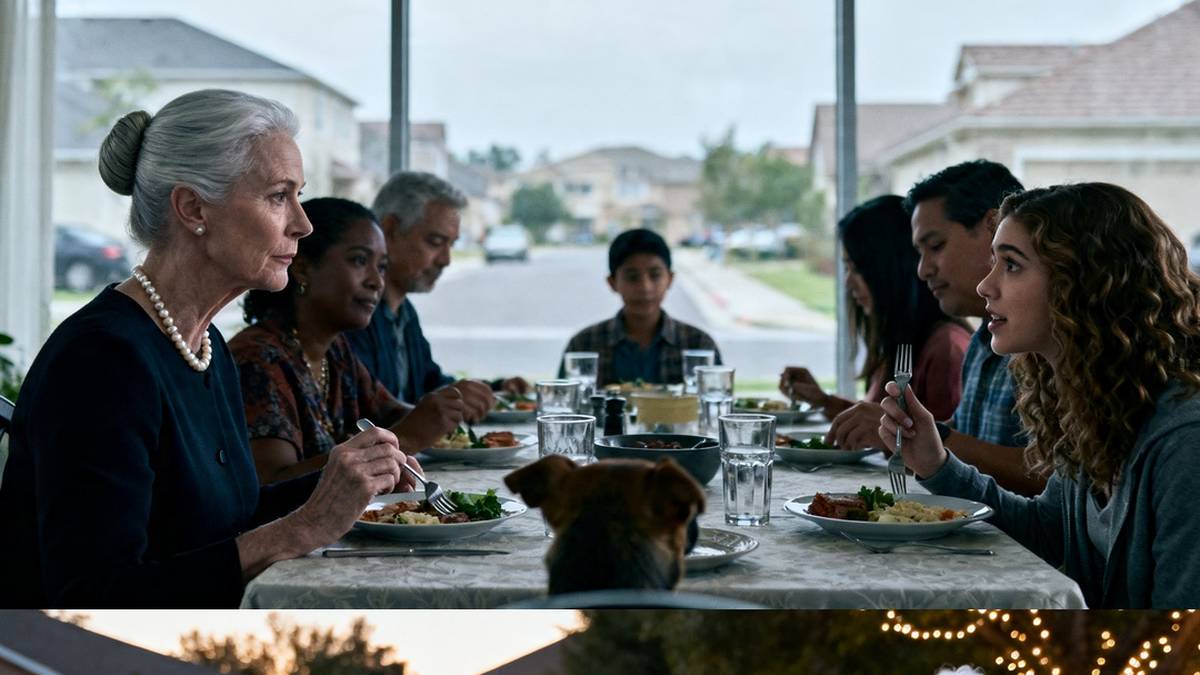
The minute Ethan walked through the door with that girl, I knew.
She had a sweet, open face, sure. Big brown eyes, a cascade of caramel curls, and a smile that practically hummed. But then she opened her mouth.
“We seen the prettiest sunset on the drive up, Mrs. Hartwell. Ain’t it somethin’?”
I felt my back teeth clamp together. *Seen.* *Ain’t.* In my foyer, right under the antique chandelier I’d spent six months sourcing for authenticity. I was a copy editor for the *Asheville Citizen-Times* for thirty-one years. I’d corrected dangling participles for senators, caught comma splices in Pulitzer-nominated features, and now my only son—my Ethan, who’d been diagramming sentences since third grade—was holding hands with a girl who treated the English language like a gumbo recipe.
Her name was Darla. Darla Rae Pickett, from a stretch of Tennessee so far back in the holler that GPS gave up. She worked at a daycare called “Kiddie Korner” — with a K — and she said things like “might could” and “we was fixin’ to go.”
I smiled like a porcelain doll for the rest of dinner. Ethan caught my eye, his jaw tight. “Mom, could you just—”
“Pass the green beans, sweetheart? Of course.” I handed him the dish, and Darla beamed at me.
“Your mama’s got such a classy way about her,” she said to Ethan, not an ounce of sarcasm. “I hope I can learn to talk right for the kids at the center. They pick up everything, you know.”
Kids. My fork stalled halfway to my mouth. Before I could spiral into a vision of little barefoot grandbabies saying “y’all’d’ve,” Ethan clarified that she meant the toddlers at the daycare. I exhaled, but it was a shallow breath. This wasn’t over. I’d raised my son to be discerning, and I’d watched him date a perfectly respectable associate professor from Chapel Hill — what happened to *her*? Now he was married. To Darla.
He’d eloped. A justice of the peace in Gatlinburg, and I found out from a text message that read, “We did it! Love you.” I didn’t speak to him for a week. But when they came back to Asheville and moved into the little bungalow he’d bought, I had to face it. I was a mother-in-law to a woman I privately referred to as “The Comma Splice.”
For the first six months, I waged a quiet war of correction.
“I ain’t got no idea where the spare key is,” she’d say.
“You *don’t have any* idea,” I’d murmur, pretending to stir my tea.
Ethan would throw me a warning look. Darla would just nod, her caramel curls bouncing, and repeat the phrase perfectly. “I don’t have any idea. Thank you, Mama Hartwell.” She refused to call me Brenda, even when I told her she could. “It don’t feel—” she’d catch herself, “It *doesn’t* feel respectful. You deserve a title.”
It was infuriating, how unoffendable she was.
My husband, George, adored her from the jump. She’d sit on the porch with him and listen to his interminable stories about fly-fishing, asking genuine questions. When Ethan started helping her with the dishes after Sunday supper — my son, whom I’d raised to believe that domestic labor was for people without intellectual pursuits — I almost said something. But George put a hand on my arm. “Let the boy be happy, Bren. She’s good for him.”
Good for him. My son, the architect, now humming while he scrubbed a cast-iron skillet.
The first crack in my armor came six months into their marriage, when Darla’s aunt Jewel drove up from Tennessee for a visit. Jewel was a stout woman with hair the color of a rusty tin roof and a trunk full of mason jars: pickled okra, peach preserves, a wheel of sharp cheese wrapped in wax paper. She took my hand in both of hers and said, “Darla talks about you like you hung the moon. Said you’re the smartest woman she ever met.”
I blinked. I had done nothing but pick at that girl’s grammar.
Later that evening, after a supper of fried chicken that I had to admit was the best I’d ever tasted, Aunt Jewel clapped her hands. “Darla, sugar, you got to sing for Brenda. Show her what the Lord gave you.”
Darla blushed. But she stood up by the fireplace, her hands clasped loosely in front of her, and she sang “Amazing Grace.” No accompaniment. Just that voice—pure and clean, with a ribbon of something raw running through it, something that ached in a way that had nothing to do with grammar or education. It was the sound of a girl who’d been raised by a village, who’d lost her own parents young and still found a reason to smile. George had tears in his eyes. Ethan looked at her with naked adoration.
And I sat there, my throat tight, thinking: *I have been a fool.*
I didn’t change overnight. Old habits. I still flinched when she said “I borrow him the truck” instead of “lend.” But I stopped correcting her. I started listening to what she was actually saying.
By the time she got pregnant with their first child, a boy they named Caleb, I was bragging about her at my bridge club. Marcy Simmons, whose daughter was a neurosurgeon in Boston who never called, said wistfully, “At least your Darla actually *wants* to be around you.” Donna’s son was on his third marriage. Elaine’s daughter had moved to Singapore and forgotten her own mother’s birthday two years running. Meanwhile, Darla brought me homemade buttermilk biscuits every Sunday and called me just to say she’d seen a bluebird and thought of me.
Fifteen years. That’s what we were celebrating last Saturday, in the backyard of their bungalow. Ethan had strung up fairy lights. George was manning the grill. The kids—Caleb, now fourteen and as lanky as his dad, and the twin girls, Lily and Rose, ten—ran around with sparklers. Darla had planned this whole anniversary party herself, and she’d asked me, shyly, if I’d say a few words.
I stood up with a glass of prosecco, the fairy lights twinkling off the crystal. Darla was sitting next to Ethan, her hand on his knee, her hair now threaded with a little silver but that smile still humming. I cleared my throat. Everyone turned.
“I’ve spent a lot of my life being right,” I said. My voice sounded older than I wanted it to. “Correct is my comfort zone. So when my son brought home a girl who said ‘ain’t’… well, the earth felt like it was cracking open.”
A few nervous laughs.
“But that girl,” I continued, and I looked right at Darla, “that girl never once said a harsh word back to me. She never held a grudge. She taught my son to dance in the kitchen. She gave me three grandchildren who know they are loved every single second. She sang in my living room and made me feel something I’d been missing for decades.” I paused, my knuckles white on the stem of the glass. “I called you a lot of things in my head, Darla Rae. Uneducated. Simple. A hick. And the truth is, the most ignorant person in this room… was me.”
I couldn’t finish. My throat closed. Darla stood up, crossed the grass in her bare feet, and wrapped her arms around me. She smelled like vanilla and fresh-cut peonies. She whispered in my ear, her accent as thick and warm as molasses, “It’s all right, Mama Hartwell. You just loved him fierce. I always knew that.”
Then she pulled back, her brown eyes glistening, and said, “Now, you gonna let me sing for y’all, or what?”
The guests whooped. Ethan grinned, his eyes wet. And I, retired copy editor Brenda Hartwell, who once corrected a wedding invitation for a misplaced apostrophe, I sat down next to my husband and listened to my daughter-in-law sing. The same clear voice, a little deeper now, weaving through the night air with an old hymn I didn’t know the name of but felt in my bones.
I reached over and took George’s hand. He squeezed it. Didn’t say a word. He didn’t have to.


