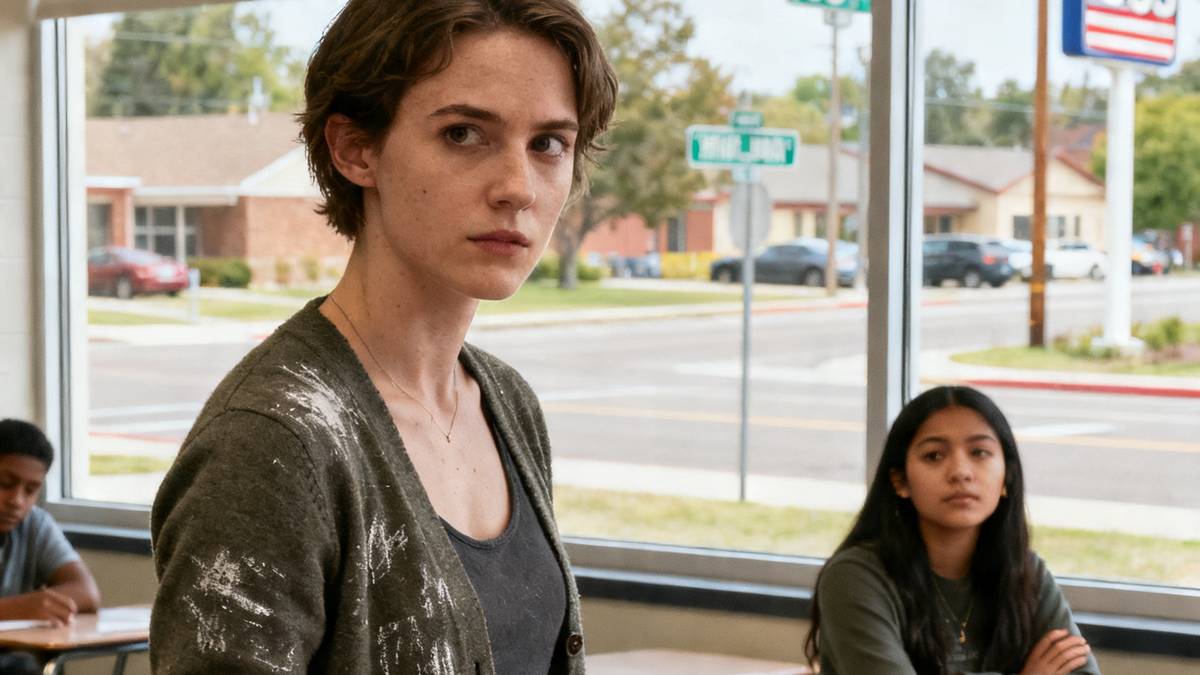
The first time Mia Vega walked into Lena Harding’s classroom, she kicked the door shut behind her, slid into a back-row seat, and put her steel-toed boots up on the desk. Just to see what the new teacher would do.
Lena looked up from the attendance sheet. Blinked once. “Those are some serious boots, Miss Vega. You work on a ranch?”
Mia’s boots came down. Not because she’d been told to. Because nobody had ever asked her that before.
“My uncle’s place,” she said. “Up near Rifle.”
“I grew up on a ranch outside of Durango,” Lena said. “Hard work.”
That was it. No lecture. No trip to the principal’s office. Just a fact, offered like a cup of coffee.
Mia Vega was sixteen, a junior, and she’d been to more schools than she could count on two grimy hands. Her file at Ridgecrest High was thicker than a phone book—truancy, fighting, a brief stint in juvie for boosting a car. She could read, barely. She could write her name and a few sentences, most of them misspelled. Every teacher she’d ever had took one look at her record, one look at her ripped jeans and her “don’t try me” face, and wrote her off before she ever opened her mouth.
Lena Harding was twenty-four, fresh out of her master’s at CU Boulder. She’d turned down offers from three suburban high schools with leafy campuses and zero metal detectors. Ridgecrest was a blink-and-you-miss-it town tucked into a valley in western Colorado, three hours from Denver. The high school was a single long beige cinderblock building, smelling of floor wax and teenage desperation. Her mother cried on the phone. “You’re throwing your education away, Lena. Those kids don’t want to learn. You can’t save everyone.”
“I’m not trying to save everyone, Mom,” Lena said. “I’m trying to teach English.”
First faculty meeting was Henderson in a school-spirit polo two sizes too small, a guy who worshipped data. He walked her through the junior class spreadsheet like a crime scene. Twenty-eight percent reading at grade level. Single-digit writing proficiency. And a number blazing red: thirty-seven percent failure rate in English last year.
“Mrs. Grimsby, the teacher you’re replacing, she had thirty years,” he said, tapping the screen with a thick finger. “She kept standards. Handed out Fs when they were earned. I expect the same. No grade inflation—not with the state board breathing down our necks.”
Lena took a sip of gas-station cappuccino. “Mr. Henderson, an F isn’t a standard. It’s a symptom. My students won’t fail. Not because I’ll inflate grades. Because I won’t let them.”
He laughed, dry. “Ambitious. Let’s see how that holds up come November.”
First week was a quiet war. Half the class wouldn’t open the book. The other half opened it and fell asleep or scrolled TikTok with the volume on. Trey Williams, a hulking defensive lineman, announced reading was “gay.” The room went still.
Lena leaned against the whiteboard. “Trey, you ever hear of a simile?”
“A what?”
“A comparison using ‘like’ or ‘as.’ For instance: ‘That comment was as clever as a brick.’” She smiled, no sarcasm. “What’s your name again?”
“Trey.”
“Alright, Trey. Let’s find out what you’re actually good at.”
Nobody had ever asked Trey Williams that. He was good at football and making freshmen flinch. That was the list. Over the next few weeks, Lena figured out he had a near-photographic memory for stories but froze at written words—classic undiagnosed dyslexia. She gave him an old silver iPod Classic she’d found at a pawn shop in Grand Junction, loaded with audiobooks. He listened to *The Things They Carried* in three days, came back looking like he’d been punched.
“That Tim O’Brien guy,” he said, setting the iPod on her desk. “He gets it. The weight of stuff. I feel that.”
She just nodded. “Yeah. He does.”
She didn’t assign detention. She assigned time. Skip the work? You stayed after the last bell, sitting in room 104 with the mountains out the window, while she graded papers. Sooner or later, it was easier to read the chapter. She never yelled. When a girl named Destiny choked on “emancipation” during a presentation, Lena didn’t rescue her. Let the silence stretch until it was painful. Then, quiet: “Start again. I got nowhere else to be.”
By October, the vibe in room 104 had shifted. Kids who’d slammed doors now argued over the characters in *Fences* like it was personal. They wrote poems that were terrible and honest. And the spreadsheet Henderson loved? A solid, boring green. No Fs.
That was the problem.
Henderson called her in the first Monday of November. His desk was so tidy it looked fake, a framed photo of him shaking hands with some state senator. “Miss Harding. Your first-quarter grades.”
“Yes, sir.”
“Not a single F.” He leaned back, the chair groaning. “You have Mia Vega in your class. Her GPA last year was zero-point-eight. Functionally illiterate, according to every standardized test she’s taken.”
“She can read,” Lena said. “She couldn’t find anything worth reading. We’re on *The House on Mango Street*. She turned in a paper last week. It’s rough, but it’s honest. Sentence structure’s improving.”
“Honest,” Henderson repeated, like the word tasted bad. “The state assessment doesn’t grade on honest. It grades on a rubric. And from what I see, you’re not teaching to it.”
“I’m teaching to the students.”
He slid a manila folder across the desk. “Performance improvement plan. You’ll follow the pacing guide, give district assessments every two weeks, and assign grades that reflect academic standards.”
“You want me to fail them,” she said, voice flat.
“I want academic integrity.”
She stood. Not tall, but still. “I made those kids a promise. I told them an F doesn’t define them. I put that letter on Mia Vega’s paper tomorrow, she’ll be boosting cars by Thanksgiving. I won’t do it.”
“Then you leave me no choice.” His voice iced over. “Terminated, effective immediately. Paid through the week. Ms. Chen will escort you to your room.”
She didn’t cry. Walked down the empty hall beside Ms. Chen, her flats squeaking, the distant roar of kids eating tater tots behind the cafeteria doors. Packed her bag: three copies of *Mango Street* she’d bought herself, a smooth gray river stone Mia had given her for luck, a stack of student poems. The posters on the wall? Left ’em. They belonged to the room.
She was in her 2015 Subaru Outback, 140,000 miles, heater fighting the November chill, when her phone buzzed. An automatic email from the school: Ms. Lena Harding no longer employed by Ridgecrest School District. All inquiries for her juniors to the main office.
Twenty minutes later, Mia Vega saw the alert on her phone while she hid in a bathroom stall, skipping biology. She didn’t skip anymore after that. Didn’t go to biology, either. Went to the cafeteria.
Trey was mid-argument about whether a defensive end could tackle a quarterback with his mind when Mia planted both boots on the table beside his tray. The clatter killed the noise.
“Yo, Vega, what the hell?” He looked up, saw her face, and the anger died. “What’s wrong?”
She held up her phone. “They fired Harding.”
“What? Why?”
“For us. For not failing us.” Her voice shook. Her eyes were wet, but she blinked hard, jaw tight. She would not cry. “For teaching us.”
Destiny pushed up her glasses. Marcus, who’d started writing raps instead of tagging overpasses, set his phone down. Word jumped table to table. The juniors in Lena’s classes, all twenty-three of them, they knew.
Mia didn’t make a speech. She just started walking. Out of the cafeteria, past a vice principal too stunned to stop her, down the main corridor toward the admin wing. Her boots echoed. Then another set of footsteps. Destiny. Then Marcus. Then Trey, pushing to the front, all six-foot-three, 240 pounds. The rest of the class, one by one, fell in. Nobody said anything. Past the trophy case, past the “Home of the Raptors” mural, past the attendance office where a secretary dropped her phone.
Henderson was on a call with HR when he heard it—a low thunder of footsteps. He frowned, told the HR director to hold, and opened his door.
The whole third-period junior English class packed his outer office, a wall of puffy winter coats and angry faces. Ms. Chen sputtered about detention. They ignored her, eyes on him.
“What is the meaning of this?” Henderson’s voice boomed. “Get back to class. All of you.”
Nobody moved.
Mia stepped forward, clutching a crumpled, oil-stained paper—her last essay. Lena had scrawled a C+ and a paragraph of feedback on the back. “You did this,” Mia said, low and dangerous. “You fired the only teacher in this building who ever looked at me like I wasn’t trash.”
“Your personal feelings are not relevant. There are standards—”
“Standards?” Trey’s voice filled the room, raw and too loud. He’d never talked to an adult like this. “You want standards? I didn’t read a book cover to cover before this year. Not one. I’m a senior next year, and I was faking it. She saw my brain just works different.” He was breathing hard. “You got a column for that in your spreadsheet? For ‘finally thinks maybe he isn’t a total waste’?”
Destiny, who used to have panic attacks before every presentation, said, “She sat with me an hour after school, teaching me to breathe. You don’t fire someone like that.” Marcus held up his phone, grade portal. “Look. F to a B-minus. We’re all passing. You just don’t like how.”
Henderson’s face mottled red. Under it, a cold trickle. He’d handled angry parents, burned-out teachers. Never a whole class. “Disperse, or I’ll call the sheriff. This goes on your records. Colleges will see it.”
“Good,” Mia said, stepping closer. “Let them. When they ask, I’ll tell them I got suspended because my teacher refused to call me a failure. Then I’ll show ’em my C-plus. You want to make that call?”
Silence. A fifty-seven-year-old man with thirty years of order and discipline and data, staring at a girl’s defiant, tear-streaked face and a crumpled essay. He saw the handwriting—cramped but legible, sentences complete. About her uncle’s ranch, the smell of sagebrush and diesel from a ’94 Ford F-250, being the only girl in a family that didn’t think she could hold a wrench. It was good.
The HR director’s voice chirped from the speakerphone. “Victor? Termination notice is uploaded. Do you authorize final processing?”
Henderson didn’t answer. He was still looking at that essay.
Then the front door banged open, freezing air blasting in, and Lena Harding walked through. Scarf still on, cheeks red. Ms. Chen had called her, frantic, and Lena had U-turned so hard she nearly beached the Subaru in a snowbank.
The kids parted. She walked into the office and stopped beside Mia. Her hands were fists at her sides. “Mr. Henderson,” she said. Her voice had no give, like a strap pulled tight. “Don’t you dare suspend a single one of them.”
He looked at her, then at the students. His empire of order was folding. He turned to the desk, leaned over the speakerphone. “Grace? Hold off on processing.” A pause. “Victor, the board already signed off. Are you sure?”
He rubbed his eyes with thumb and forefinger, hard. “I’m sure. I’ll handle it.”
He killed the call. The silence after was dead air. He didn’t look at Lena. He addressed the window, voice scraped raw. “Your PIP gets adjusted. Alternative assessment methods. You’ll report to the district coordinator for innovative strategies. But you’re on thin ice, Harding. The board still has a file. One slip, and this conversation goes different. Understood?”
She gave a single nod. “Understood.”
It wasn’t an apology. It was a truce with a blade still hanging.
Mia didn’t let anyone cheer. She shot a look back that froze them all. Then she walked to Henderson’s desk, smoothed her C-plus essay on the polished mahogany, and set a tiny grouchy-looking octopus toy on top—arcade prize from the mall, supposed to flip to angry, but it just looked grumpy.
“For your desk,” she said, flat. “Maybe it’ll help with the stress of all those standards.”
She turned and walked out. Twenty-two classmates followed. Lena gave Henderson one last unreadable look, then left too.
In the hallway, they didn’t celebrate. They stood in a loose huddle by the water fountain, adrenaline crashing, shaky silence.
Mia cracked first. A choked laugh. “That octopus. His face.”
Trey bent over, hands on knees. “My heart’s beating so fast I think I’m gonna puke.”
Lena looked at them—all twenty-three, sweaty and wild-eyed and terrified by what they’d just done. Her throat bobbed. “You’re all insane. Completely certifiable.”
“Learned from the best, Miss Harding,” Destiny said.
The bell shrieked, end of period. They didn’t move. In a minute the flood would come, but for now they were the only people in the world.
Lena cleared her throat, trying for teacher-voice. “Alright. You’ve had your moment. Miss Vega, I hope that essay was your best work, because you just made it part of the permanent record.”
Mia shrugged, ghost of her old self flickering, but now it was a game. “It was a C-plus. I figure I can do a B-minus.”
“B-minus my foot. We start *Catcher in the Rye* next week. You’re writing an A paper.”
The hallway began filling, a river of backpacks and noise. They were just kids again, swallowed by the daily chaos. Lena walked to room 104. The copy of *Catcher* was waiting on her desk. She opened it to the first page, uncapped a dry-erase marker, and wrote one word on the board for the next class.
“Tomorrow.”


